
What Is NYT Connections and Why Mashable Matters?
New York Times Connections is a daily word‑linking challenge that asks players to group twelve words into four related sets. The game’s popularity skyrocketed because it blends vocabulary skill with lateral thinking, turning a simple list into a brain‑teasing adventure. Mashable stepped in as a trusted ally, offering daily “connections hint mashable” insights that keep solvers ahead of the curve.
Since its launch, Connections has become a cultural touchstone for commuters, students, and puzzle enthusiasts alike. Each morning, the grid refreshes, presenting fresh themes that range from pop culture to scientific terminology. For many, Mashable’s hint service is the first stop after the puzzle appears, providing a subtle nudge without spoiling the solution.
The partnership between the NYT and Mashable thrives on timely, spoiler‑free guidance. By analyzing patterns and previous answers, Mashable crafts hints that respect the puzzle’s integrity while offering clarity. This balance has turned “connections hint mashable” into a searchable phrase that many users type into Google each day.
How Mashable Generates Daily Hints
Every 24 hours, Mashable’s editorial team reviews the new Connections grid alongside the NYT’s official answer key. They then distill the core concepts into concise clues that point to the underlying theme without naming any specific words. This process ensures that each hint remains useful for beginners and veterans alike.
The workflow blends human intuition with algorithmic assistance. Automated scripts scan the word list for semantic clusters, while editors verify the relevance and difficulty level. The result is a polished “connections hint mashable” entry that appears on the Mashable site before most players have even started the puzzle.
Because the hints are released early in the day, readers can incorporate them into their solving strategy before the afternoon rush. Mashable also timestamps each hint, making it easy to reference past puzzles and track personal progress over time.
- Word‑list analysis using natural‑language processing
- Human editorial review for nuance and accuracy
- Publication on Mashable’s dedicated Connections page
Decoding the Hint Structure
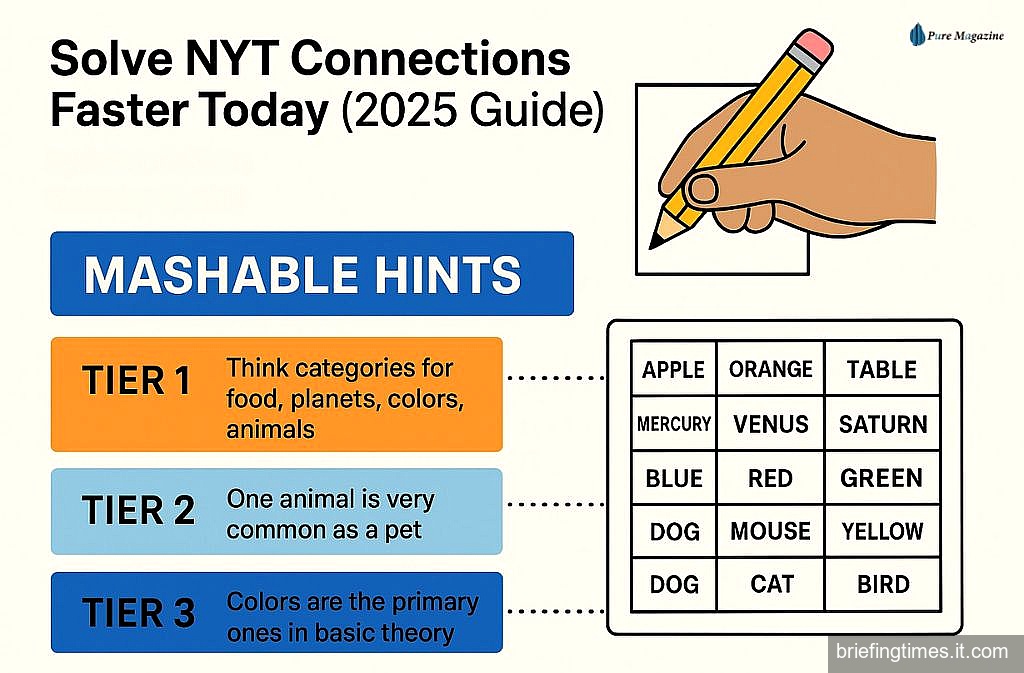
A typical “connections hint mashable” note follows a three‑part format: a brief theme description, a subtle clue about one of the four groups, and a reminder to avoid over‑reliance on the hint. This structure guides the mind toward the correct association while preserving the puzzle’s challenge.
The first sentence often hints at the overarching category, such as “Think about things that travel together.” The second sentence narrows the focus, for example, “One set involves items you’d find on a road trip.” The final reminder encourages independent thinking, reinforcing the game’s educational value.
Understanding this layout helps players extract maximum benefit. By recognizing which part of the hint aligns with which set, solvers can prioritize their guesses and reduce trial‑and‑error. Over time, readers develop an intuition for spotting the subtle cues embedded in each hint.
Strategic Use of the “connections hint mashable”
When you first glance at the daily grid, resist the urge to jump straight to the hint. Instead, scan the twelve words and jot down any obvious pairings. This initial scan primes your brain, making the subsequent “connections hint mashable” more effective as it confirms or redirects your instincts.
After reviewing the hint, apply a process of elimination. If the clue references “items that glow,” identify all words that could fit that description and test them against the remaining groups. This method narrows possibilities without giving away the answer.
Finally, cross‑check each tentative group against the other three. The puzzle’s design ensures that each word belongs to only one set, so a mis‑fit in one group will usually surface in another. Using the hint as a compass, rather than a map, leads to a satisfying “aha!” moment.
Common Pitfalls and How to Avoid Them
One frequent mistake is treating the hint as a direct answer key. Players who rely solely on the “connections hint mashable” often overlook alternative interpretations that the puzzle designer intended. To avoid this, always consider the hint as a guide, not a guarantee.
Another error involves over‑grouping based on superficial similarities. For instance, two words might share a prefix but belong to different thematic sets. The hint helps you differentiate by focusing on deeper connections like function, origin, or cultural context.
Finally, many solvers forget to reset their mental model after each successful group. Once a set is confirmed, revisit the remaining words with fresh eyes, as the hint may subtly apply to the new subset. This iterative approach prevents stagnation and speeds up completion.
Advanced Techniques for Power Players
Seasoned puzzlers often employ a “reverse‑hint” strategy, where they hypothesize possible groups before checking the hint for confirmation. This proactive method sharpens pattern‑recognition skills and reduces reliance on external assistance.
Another high‑level tactic is the “semantic web” approach: map each word to potential categories on a virtual whiteboard, then look for intersecting nodes that match the hint’s theme. This visual method reveals hidden relationships that might be missed in a linear scan.
Power players also track recurring hint patterns over weeks. By noting that certain phrasing—like “think of pairs that rhyme”—appears regularly, they can anticipate the type of connection before the hint is even published, giving them a competitive edge.
Where to Find Updated Hints and Community Support
For the most reliable “connections hint mashable” updates, bookmark Mashable’s dedicated Connections page each morning. The site refreshes the hint shortly after the NYT releases the new puzzle, ensuring you have the latest guidance before the day’s rush.
Beyond Mashable, a vibrant community of solvers shares strategies on forums and social media groups. Engaging with these communities can provide additional perspectives, but remember to keep discussions spoiler‑free to preserve the fun for newcomers.
When you’re ready to dive deeper into puzzle‑solving techniques, explore related resources that expand on word association theory and cognitive training. For a curated collection of design‑focused articles that complement your puzzle practice, visit your natural anchor text for inspiration.
